
What does it mean to truly belong in a place? Is it simply a matter of legal status, a paycheck, or the language we speak? Or is it about something deeper—a sense of acceptance and connection to the community around us? These questions resonated with me as I ventured through Portugal, trying to make sense of what it means for migrants to find their place in a society.
I arrived in Porto with a belief that Portugal, recognized as a leader in labor market integration according to the Migrant Integration Policy Index (MIPEX) 2020, would have a relatively seamless system for welcoming migrants. My expectations were shaped by statistics and reports that praised the country’s approach. But what I soon discovered was a Portugal amid political and social change—a place that, despite its past, is struggling with an evolving identity and growing challenges when it comes to integration.
My first conversation with Professor José Varejão at the University of Porto’s Faculty of Economics unraveled much of this complexity. We delved into the history of migration to Portugal, discussing the various waves of immigrants that have shaped the country and the balance between migration policies that protect migrants and locals alike. He pointed out how Portugal’s regulatory environment is increasingly becoming a barrier to further migrant integration in the labor market.

From Porto, I ventured to Gaia, a suburb just across the river, to meet Gabriela Torres at the Associação de Solidariedade Internacional (ASI). This organization plays a key role in supporting migrant communities, offering services and advocacy to help them navigate their new lives in Portugal. During our conversation, Gabriela shared her experiences working closely with migrant families, as well as her own story as a migrant, illustrating that integration isn’t just about paperwork or learning the language. It’s about building relationships, finding opportunities, and truly feeling like a part of society.
Next, I traveled to Lisbon to visit Casa do Brasil de Lisboa and meet with Patricia Brederode. As a Brazilian myself, I was particularly interested in how fellow Brazilians—despite our shared language and cultural ties with Portugal—still face significant barriers in the labor market. Many struggle due to bureaucratic red tape and limited access to professional networks. During our conversation, I learned how Casa do Brasil plays a vital role in providing support for these migrants, offering essential services like job placement assistance and career counseling to help them navigate these obstacles and find their place in the workforce.
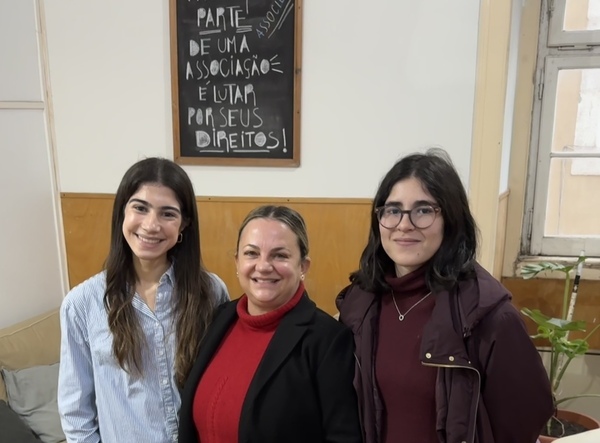
I also met with another scholar, Professor Alina Esteves, at the University of Lisbon. Our conversation took a turn toward politics and public perception, as we discussed how native Portuguese citizens view migrants in their country. Professor Esteves spoke about the rise of nationalist rhetoric and the political pushback against immigration in recent years. While Portugal once embraced migration as part of its cultural identity, the political narrative around migrants has changed, and the idea of migration as an opportunity for growth is increasingly being questioned by the native population. As I reflect on my time in Portugal, I cannot help but feel a sense of dissonance. Portugal may still be one of the better-performing countries in terms of labor market integration, but the challenges migrants face in reality are becoming more pronounced, and the society itself is shifting under the weight of its evolving discourse on migration.
“ ... go beyond the numbers, indices, and reports. Talk to the people, organizations, and experts who are living the experience. They will tell you the stories that no policy document can capture.”
What I thought would be a straightforward study of policy and success turned out to be a complex exploration of identity, belonging, and the barriers migrants face in a changing world. If I were to offer one piece of advice to future researchers or students working on migration studies, it would be to go beyond the numbers, indices, and reports. Talk to the people, organizations, and experts who are living the experience. They will tell you the stories that no policy document can capture.
The opportunity to conduct research in Portugal, supported by the Nanovic Institute, has been a transformative experience. Through the institute’s generous support, I was able to immerse myself in a rich, complex field of study and gain first-hand insights into the intricacies of migration and integration. I am incredibly grateful for the chance to not only work alongside esteemed scholars but also to engage with individuals whose personal experiences have greatly informed my research. As I continue my research, I am eager to contribute to a broader dialogue on these critical issues, with a clearer understanding of the pressing needs and potential solutions for migrant communities in Europe.
Leticia Cardoso Queiroz ’26 is a Notre Dame student with majors in business analytics and global affairs with minors in European studies and finance. During the winter break of the 2024-25 academic year, she traveled to Portugal to study the labor market integration of migrants.
Originally published by at nanovic.nd.edu on August 25, 2025.