
The Nanovic Institute for European Studies releases today its latest student-created digital exhibition, “Unveiling the Climate Apocalypse.” This project is the culmination of the work of an undergraduate research group organized by the institute during the fall 2024 and spring 2025 semesters.
Five students each wrote about an artist, author, or text and their response to the climate crisis in which humankind finds itself. Some, like Banksy, are household names whose artistic output has gained considerable public attention in their engagement with climate change. Others, like the video game Anno 2070, are less likely to be the subject of an academic essay. This project puts these texts into conversation in new ways, highlighting the importance of bringing together different texts to fully explore our response to the climate crisis.
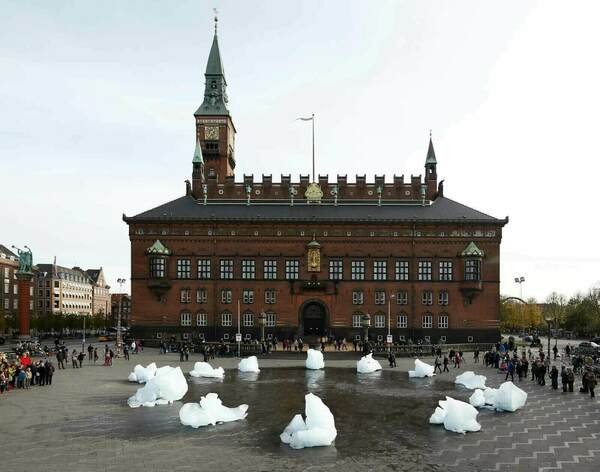
The exhibition invites viewers to consider how different media types can use the concept of the climate crisis differently, and how the medium itself shapes its message and impact.
Encountering sunken life-sized sculptures off the Grenadian coast. Exploring an ice cave in Iceland. Walking past enormous blocks of Greenland ice, slowly melting under the shrouded sun of Copenhagen. Controlling an outpost of the last surviving humans in a video game. Studying satirical adaptations of famous paintings while navigating a horde of rats. Or reading a call to action by a lifelong climate campaigner and political leader. Each brings the viewer into a different relationship with the subject of climate change, and each asks—even demands—different responses from its audience.
The students come from a diverse range of academic disciplines: aerospace engineering, mechanical engineering, computing and digital technology studies, political science, marketing, and global affairs. This project allowed them to approach academic research and writing from a new angle and develop skills adjacent to their main fields of study. By reading and using critical theory from literature and art history, and by close-reading the media texts within their geographical, cultural, or artistic context, each student has written a compelling analysis of the impact that such works can have on the public. As one student reflected on the project, “especially being unrelated to my major, it’s allowed me to expand my perspective and approach to learning.” These same skills, defined by one student as “research, consolidating findings into succinct and compelling written pieces, collaboration and developing links across different research topics, [and] applying revisions and feedback to work,” will support the researchers as they continue their studies at Notre Dame.
We’ve had to deal with climate change before, but the speed and scale in our current moment are quite unique. Our circumstances raise difficult questions: how do we as individuals respond to climate change? What ought we do? This project is part of that discussion, and though things can look bleak at times, we end with hope and optimism.
I had the pleasure of leading this project and working with our students to bring it to fruition. My own research is on Old English literature, particularly homilies that center on the apocalypse. For this project, though, I wanted to bring these conversations into the 21st century and work with an issue we are facing today. People often speculate that my research on the apocalypse must feel particularly relevant today. And in many ways, they’re right. We’re facing a lot of the same problems people had to contend with a thousand years ago: food insecurity, political instability, disease, war. We’ve had to deal with climate change before, but the speed and scale in our current moment are quite unique. Our circumstances raise difficult questions: how do we as individuals respond to climate change? What ought we do? This project is part of that discussion, and though things can look bleak at times, we end with hope and optimism.
As with previous Nanovic exhibitions, this project will remain online indefinitely as a unique research outcome. In addition to this online collection, the students also presented their work to the Notre Dame community at the Nanovic Institute’s second annual Undergraduate Research Conference in European Studies. This was an opportunity for the students to share their research, respond to questions from faculty, and place their work on this project within broader conversations around climate change. For many, this chance to engage directly with their peers and professors was a highlight of the project.
This online exhibition explores themes of climate change, climate justice, and agency that connect with the strategic priorities of the University of Notre Dame’s 2033 Strategic Framework, the Keough School of Global Affairs, and the Nanovic Institute. Viewers are invited to consider how art and literature can help us to understand the climate crisis, and to examine our own role in responding to this existential threat.
Student Researchers
-
Anna Massman ‘28
-
Catherine Paris ‘27
-
Jane Palmer ‘26
-
Monay Licata ‘25
-
Dani Fielding ‘28
Project Leader
-
Will Beattie
Originally published by at nanovic.nd.edu on June 03, 2025.